





TW_N13 Geotrail Kötschach-Mauthen
Many extraordinary fossil stones have been found in Kötschach-Mauthen, which can now be admired between the Gailtaler Dom in Kötschach and the Hammerle in Mauthen. The fossil stones are complemented by...
Many extraordinary fossil stones have been found in Kötschach-Mauthen, which can now be admired between the Gailtaler Dom in Kötschach and the Hammerle in Mauthen. The fossil stones are complemented by stone cultural assets, such as the old pillory or the colossal "Unterbär" from Mauthen.


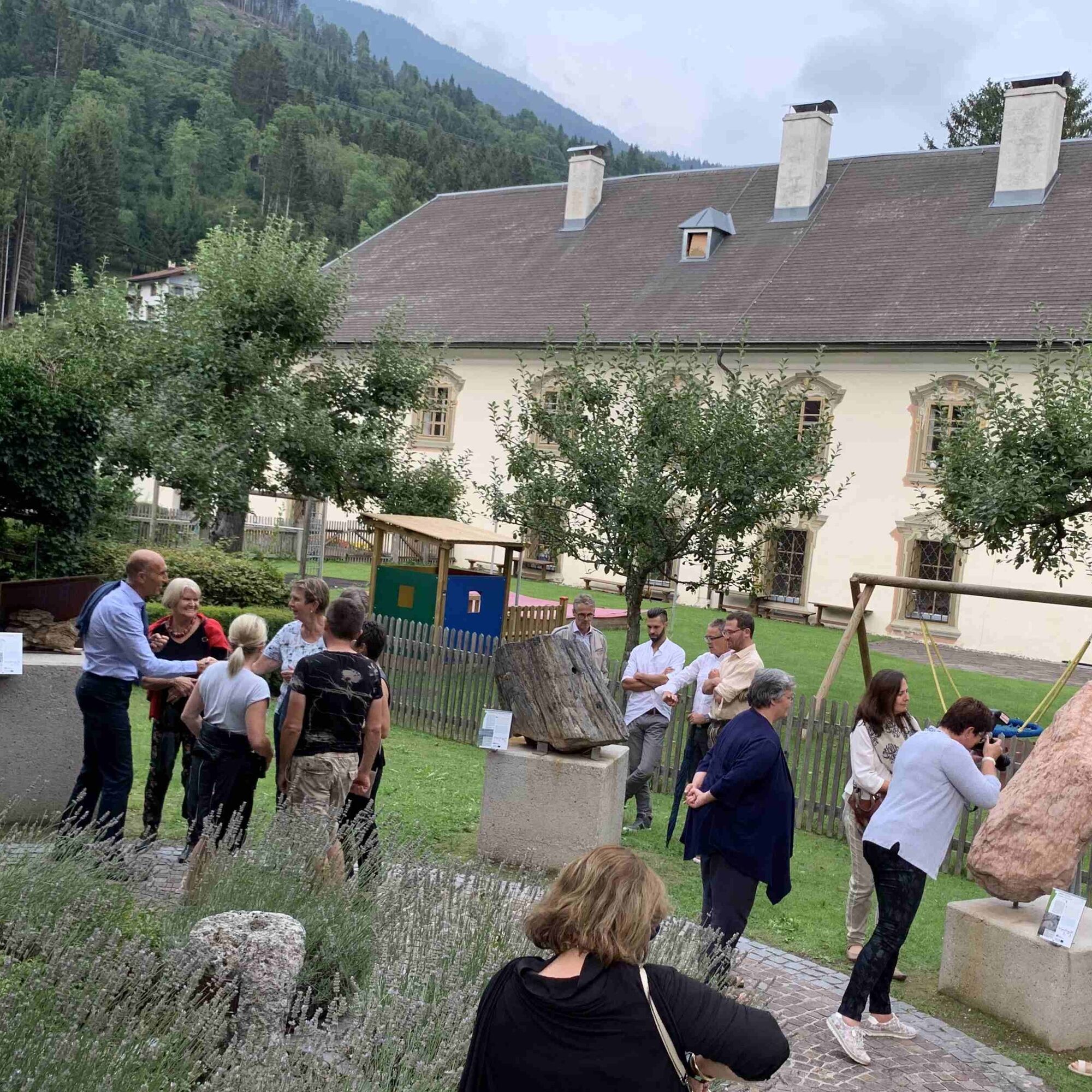

Stop 1 - Around the Gailtaler Dom
Stone 1 - Lion of the Kellerwand
The limestone block owes its name to its appearance, as it resembles a lion carrying a backpack. On closer inspection, green copper mineralizations can be seen. The approx. 30 kg stone was found in 2014 in the Kellerwand. It formed in an extremely shallow warm sea about 380 million years ago with the help of algae. Organisms are often involved in the formation of limestone. The algae converted calcium dissolved in water into solid calcium films that gradually built up the stone.
Stone 2 - Ammonites - Testimonies of the Ice Age
This striking limestone block was recovered in 2010 in Laas. It impressively documents the path of the inland glacier of the last Ice Age since the actual occurrence area of the limestone is in the Lienz Dolomites. From there, the glacier transported the stone over the Gailberg to Laas, when it overflowed into the Gail Valley - crossing the watershed. Very clearly visible in the 180-million-year-old block are decimeter-sized ammonites, marine creatures now extinct.
Stone 3 - Petrified tree from the Equator
This 285-million-year-old petrified tree trunk was recovered above today's Laas hospital in the 1960s in the Laas forest. It is not the longest but the mightiest tree trunk ever found in the so-called Laas Formation. In this rock formation, fossil trackways of six different proto-reptiles, desiccation cracks, ripple marks, crab traces, and more were also discovered. All these finds characterize the then living environment as a highly inhabited floodplain near the equator, several hundred kilometers away from the sea inland.
Stop 2 – Town hall
Stone 1 - Orthoceras (straight horns) - gigantic marine creatures
The almost 200 kg heavy limestone block was flown into the valley by helicopter in 1987 from the south side of the Rauchkofel from about 2,100 m altitude. Several shells of long-extinct orthoceras can be seen in the approx. 400-million-year-old stone. These marine creatures were ancestors of today's squids, up to 10 meters long. The largest shell ever found in the Karnische Alps, measuring 65 centimeters long, runs across the stone in front of you.
Stone 2 - Proto-reptiles - the first land dwellers
This rock slab with fossil trackways of proto-reptiles was recovered in the late 1970s in the Kötschach mountain. The 285-million-year-old trackways are from up to three-meter-long stocky animals (diadectomorphs). They were herbivores. Of particular importance are the trackways as they represent the link between amphibians and reptiles. The trackways are the only evidence of these animals in the entire Alpine region.
Stop 3 – On the Gail
Stone 1 - Net limestone - a striking structure
This limestone block comes from rockslide material from the Lower Bischofalm. The rock formed from clay-rich lime mud deposited about 390 million years ago in sea depths of over 100 meters and contains only microscopically small fossils. During the consolidation of the lime mud, the darker clay particles enveloped the lighter lime cores, resulting in the striking net-like structure. According to its main occurrence area in the Carnic Alps, the net limestone is referred to locally as the Findenig Formation.
Stone 2 - Gail Valley “jewels”
The rock block comes from the Gail Gorge in the Lesachtal and belongs to the so-called Gailtal crystalline. The rocks of the Gailtal crystalline were affected by the Variscan orogeny much more strongly about 320 million years ago than the Carnic Alps and buried to great depths. The fossils were destroyed while new minerals like garnets and staurolites were formed. Both are used as gemstones. Particularly the staurolites up to five centimeters long are extraordinary for Carinthia. The knobby white quartz and the bushy biotites crystallized later in fractures.
Stone 3 - Millstones from the Kötschach mountain
This typical red rock block of the region has extraordinary hardness due to its quartz inclusions. Therefore, it was used as a millstone. The red rocks in the Kötschach mountain come in two forms. The 285-million-year-old rocks of the Laas Formation are rich in fossils and show components from the Gailtal crystalline, as they represent erosion material from it. The younger Gröden Formation, however, contains volcanic inclusions and testifies to former volcanism.
Stop 4 – Mauthen center
Market stone of Mauthen
The market stone is one of Carinthia’s protected monuments. The octagonal stone pillar with a spherical top was used for erecting the market square but also served as a pillory.
Stop 5 – Forest bath
Stone 1 - Coral reef - testimony of tropical seas
This limestone block weighing more than 4 tons was discovered in 2006 near the Maria Schnee Church in Mauthen. It most likely originates from the Kellerwand, from where it was transported to Mauthen by the glacier of the last Ice Age. The huge block consists of corals of the extinct genus Favosites, which formed widely branched colonies made of calcite tubes inhabited by individual polyps. The coral reef was part of a reef of a tropical sea that spread about 380 million years ago in the western Plöcken area.
Stone 2 - Coral reef of unknown origin
This 630 kg limestone block with its striking fringed fossils was discovered in 2010 in the Mauthen gorge. It could be flown out of this gorge thanks to the effort of many volunteers and a helicopter. Although very striking, the fossils were difficult to identify despite intensive scientific work. Scientists ultimately agreed on fossil corals of the genus Hillaepora. They formed colonies and were reef-building. The true place of origin of the rock block is still unknown; the Kellerwand is suspected.
Stone 3 - Orthoceras - backward swimmers
The limestone block was washed up by the Valentinbach and recovered in 2015. The colorful stone shows shells of extinct orthoceras in their typical length of about ten centimeters for the Carnic Alps. Their pointed conical shell consisted of gas-filled chambers through which the animal regulated sinking and rising in the water. At the open end of the shell, a head with tentacles protruded, which were not used for locomotion. Movement took place by jet propulsion. The animals pressed water in with high pressure, shooting backwards.
Stop 6 – Alpine camp
Tabaluga in Wetzmann
The bizarre stone at the Alpine camp immediately evokes the little green dragon Tabaluga. In fact, it is a fossil-rich limestone strongly weathered by precipitation.
Stop 7 – Hammerle
Pochstein
This colossal stone was found in Mauthen in the "Hammerle." With a wooden beam attached, it was probably used as a hammer for breaking rock in the old hammer mills.
Ano
Ano
Ano
No special equipment necessary.Wind and rain protection advantageous!
FAIR PLAY & RESPECT:
Mindfulness for nature – landowners – your health.... and safety on the mountain have the highest priority for your route and related route planning!
Therefore, find out about the rules of conduct before every hike - Mountain safety - as well as the current weather conditions.
Waste disposal:
Waste is not always avoidable – but it has no place in nature and must be disposed of properly (preferably in the valley or at home).
Emergency numbers:
European emergency number: 112 (accessible via any available network)
Alpine emergency Austria: 140
Arrival by car:
From Hermagor via the B111 (Gailtal Road) or from Oberdrauburg via the B110 (Plöckenpass Road) to Kötschach-Mauthen.
The most sustainable travel option is by train to Oberdrauburg (coming from Lienz or Villach) or to Hermagor (coming from Villach).
From Oberdrauburg or Hermagor you can then reach the town of Kötschach-Mauthen by bus.
Details at - Nassfeld mobility info and Kärntner Linien route planner
Free parking is available in Kötschach-Mauthen at the town hall, as well as at the forest bath in Mauthen.
Are you looking for hiking tips in the region as well as a state-certified guide for a guided mountain hike?
You can find this and many other infos at - Route tips and provider info
In Kötschach-Mauthen there are numerous year-round open dining options – details at Service A-Z.
Webové kamery z prohlídky
Získejte přehled
Vždy živě na místě s více než 9 500 webkamerami. bergfex Jako uživatel Pro si nyní můžete zobrazit odpovídající webové kamery pro mnoho prohlídek v aplikaci prohlídky z. Můžete si tak přímo prohlédnout aktuální podmínky.
Oblíbené prohlídky v okolí
-
4.8
Pirknerklamm (C)
středníVia ferrata 2 km -
4.9
Karnischer Hauptkamm - Hohe Warte 2.780m - Hike and Bike
heavyHorská turistika 19.5 km -
3.9
Summit hike to the Hochstadel
středníTuristika 7.83 km -
4.3
Mountain bike route from the Hubertus Chapel to the Wolayersee
heavyMountainbike 9.06 km -
3.7
Cellon-Stollen und Senza Confini auf den Cellon und Steinberger Weg zum Abstieg
středníVia ferrata 7.09 km -
5.0
Plöckenhaus - Polinik - Plöckenhaus
heavyTuristika 10.9 km -
4.2
Assing - Oberraster Alm - Lumkofel (2,287 m)
středníTuristika 9.45 km -
5.0
Valentin-Wolayersee-Runde
středníTuristika 12.4 km -
3.7
RW_N61 Kleiner Pal (1,867 m)
heavyTuristika 6.52 km -
4.5
Bread & Morende Trail
středníTuristika 11.3 km
Pěší turistika a stopování

Nenechte si ujít nabídky a inspiraci pro vaši příští dovolenou
Vaše e-mailová adresa byl přidán do poštovního seznamu.