


Bar to Bar in mountain bike - Tappa 6 - Monforte d'Alba - Verduno
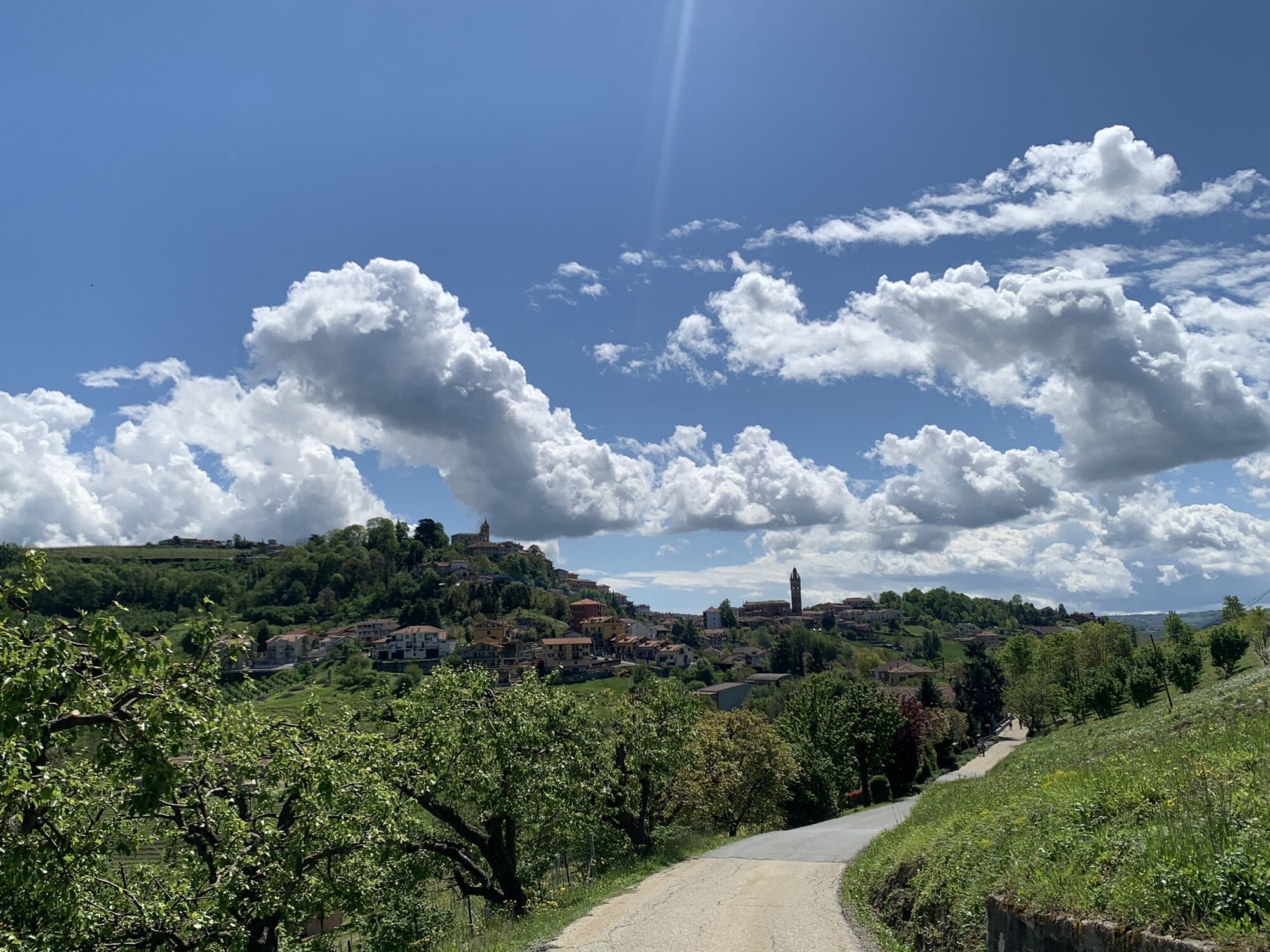
Another stop immersed in the Barolo vineyards, crossing the most famous and sought after crus by enthusiasts from all over the world, filling your eyes with the "sea of vineyards" from the Belvedere of...
We leave Monforte on asphalt in the direction of Barolo up to the small church of San Pietro, where we take the crossroads on the right for the Bricco of the same name and we walk, still on asphalt, the half-circle around the wooded hill, until we find the headland that descends between the rows towards Cascina Sòt, then briefly merge onto the provincial road for Barolo on the right. After a few meters, we take the left fork for the hamlet of Panerole and, then, immediately right between the first houses, we turn slightly uphill. After the last house the road becomes grassy again, goes over the crest of the hill and gradually descends (D1) into the valley below Novello. Here we keep right at the various crossroads (all signposted) and enjoy the quiet of this valley surrounded by vineyards and dotted with willows.
However, our main route turns right shortly after the entrance, to take the ancient local road of Terlo, a well-known Barolo vineyard, which runs flat up to the town, with just some gentle ups and downs following the waves of the hill. So we also arrive at Barolo from above, from Via Vittorio Veneto, right above the historic Cantina Pira, in the upper square of the town. The road that descends downwards runs between the houses and Art Nouveau buildings of the nineteenth-century expansion of the village, while at the next crossroads you enter the medieval fabric of the town which ends on the fortress with the Falletti Castle (today WiMu – Wine Museum and Enoteca Regionale del Barolo), the parish church and the brotherhood that summarize the essence of each village in the Langa.
In the Falletti Castle, thanks to the Marchioness Giulia Colbert, modern Barolo was born... or rather it is one of the three historical cradles, with Grinzane Cavour by Count Camillo Benso and Verduno by King Carlo Alberto. However, the Marchioness should also be remembered for the countless charitable works to which she dedicated her long widowed life (orphans, single mothers, prisoners, etc.) and for her support (she was from the Vendée) for the ideas and movements of the Risorgimento (she welcomed and kept Silvio Pellico serving as librarian). For the Church of Rome, Giulia Falletti is today blessed and, as they say, now in the odor of sanctity, alongside the many social saints of the 19th century (from Don Bosco to Cottolengo, to name the two best known). Also unmissable is the Corkscrew Museum, a private initiative of the collector Paolo Annoni, who made his incredible collection accessible to everyone. Our route continues from the upper square, to which we therefore return after the necessary tour of the town, to exit towards Alba and, after passing the roundabout for Novello (first exit), shortly after take via Bergesia on the left, which falls (D3) from Cannubi (one of the most important crus in all of Barolo) in the valley below.
From the Cannubi ridge the gaze rests on the infinite hill of La Morra, the queen of Barolo, with its 513 metres, embankment and bulwark of the cold winds of the Cuneo plain, the true creator of the microclimate of this unique and unrepeatable microzone. Here before us are the crus of Sarmassa, Fossati, Cerequio, La Serra and Brunate, desired by all collectors for their unmistakable elegance. From the valley we immediately go up to the headland between the rows of Sarmassa and Cerequio (S2) to arrive at the small village, which today houses a charming relais surrounded by vineyards. The next climb that will take us to La Morra is one of the steepest of all the Langhe (extreme S3, fortunately on asphalt), climbing practically straight up to the Fontanazza crossroads (from which if you go down to the right you will shortly reach the Chapel of Barolo, a crazy Pop-Art idea by Sol Le Witt and David Tremlett), to then run along the coast of the hill and, finally, enter the town with a final climb (S2).
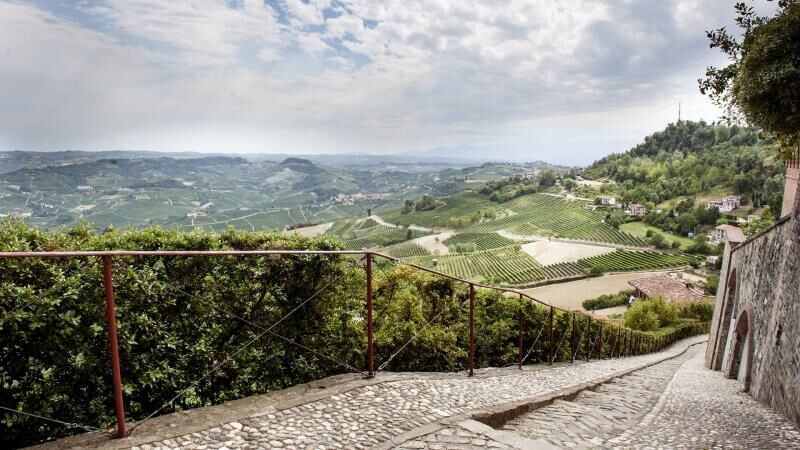
La Morra deserves to be explored in its entirety, starting from the bastions and then entering the grid of checkerboard streets that go back up to the bell tower (as in Monforte, the last fragment of the disappeared castle). The square that everyone knows as "del Belvedere" justifies its name, opening up like a bird's eye view of all the Barolo vineyards. Good mapping allows you to identify the towns that dot the hills, while the darkest line right on the horizon is already the impalpable border between Piedmont and Liguria, between the hills and the sea. The Statue of the Winemaker has just this year revealed a classic Langhetti "secret" in its base: bottles and bottles of Barolo (from the year in which it was erected) left there, hidden in secret, for the happiness of the lucky finders and for the greater memory of the producers! From La Morra we exit towards Verduno to take the Loreto dirt crossroads on the right after a few kilometers of asphalt, which will take us to the chapel of the same name (on our right) downhill (D1), and then continue until it intersects the provincial road again and, after 1 km, take the aqueduct climb on the left, which descends (D1) to the town of Verduno.


Oblíbené prohlídky v okolí
-
Barolo Classic
heavySilniční kolo 50.0 km -
The hills of Count Cavour
světloSilniční kolo 35.8 km -
5.0
The Ascents of Champions
heavySilniční kolo 114.2 km -
Confraternity of San Michele - Serravalle Langhe
středníTuristika 14.6 km -
Bar To Bar in mountain bike
heavyCyklistika na velkou vzdálenost 68.6 km -
BTB - Bar To Bar - Stage 5A: Serralunga d'Alba - Monforte d'Alba
středníTuristika 10.8 km -
Sentiero Tanaro: Tappa 1 Dogliani (Centro Storico) - Clavesana (Loc. S. Giuseppe)
světloMountainbike 12.1 km -
BTB - Bar To Bar - Stage 6: Monforte d'Alba - Verduno
středníTuristika 12.2 km -
BTB - Bar To Bar - Stage 7: Verduno - Alba
středníTuristika 15.3 km -
BTB - Bar To Bar
středníTuristika 121.0 km
Pěší turistika a stopování

Nenechte si ujít nabídky a inspiraci pro vaši příští dovolenou
Vaše e-mailová adresa byl přidán do poštovního seznamu.