




HERITAGE VISIT - OLARGUES NEW TOWN OF THE MIDDLE AGES
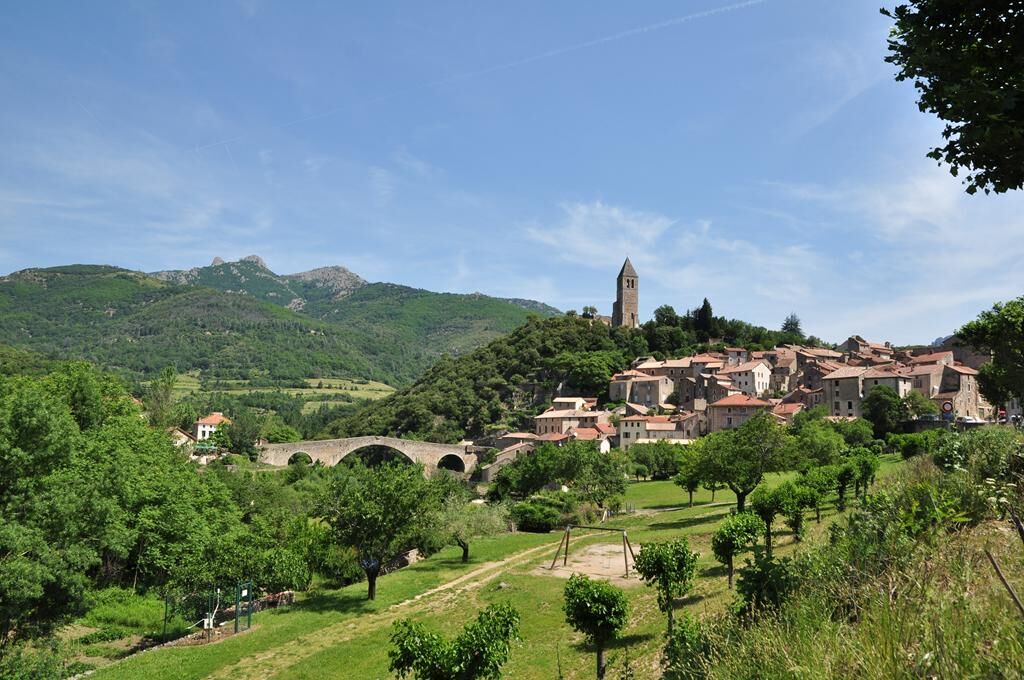
This route guides you to the heart of Olargues, a medieval town from the 12th century whose every street, step, and turn once responded to a defensive strategy. Climbing towards the dungeon-bell tower,...
This route guides you to the heart of Olargues, a medieval town from the 12th century whose every street, step, and turn once responded to a defensive strategy. Climbing towards the dungeon-bell tower, you discover ramparts, gates, the castrum, and the old bridge, witnesses of a prestigious past. From the summit, the panorama reveals the harmony of the village, today one of the Most Beautiful Villages of France. An authentic and peaceful walk.

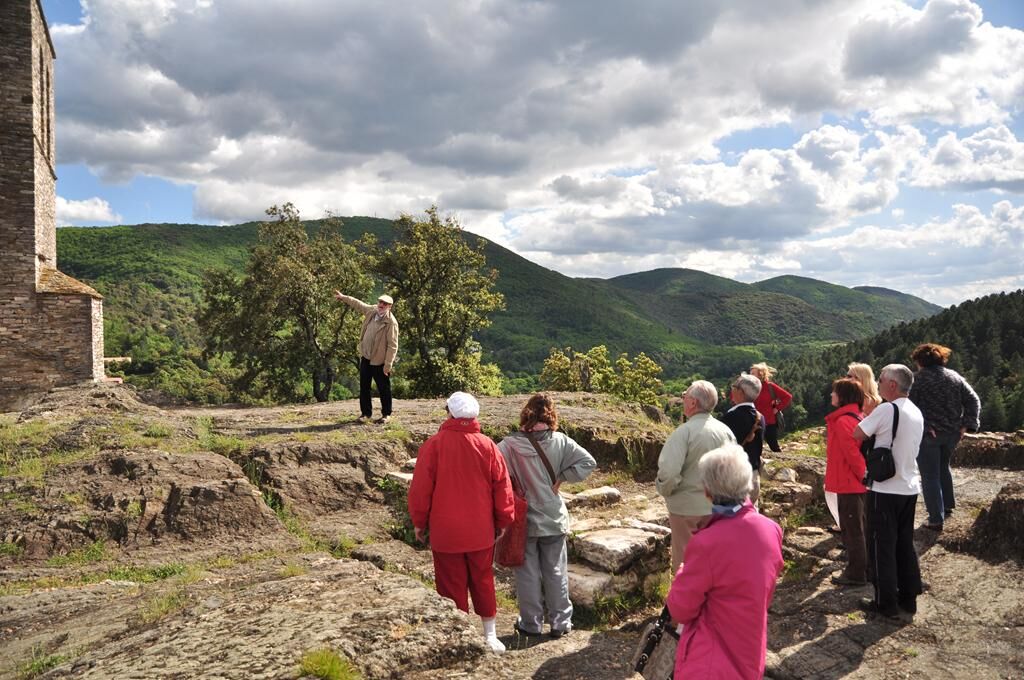

1
Start - The foundation of Olargues Starting point of the circuit: the Comportes room, built on the site of the former Saint-Étienne church, once the cemetery church of Olargues. Going up the Gare avenue, you pass through the old cemetery, moved at the beginning of the 20th century. Then enter the village through the Pourtalet gate.
2
01- The Pourtalet Gate The Pourtalet Gate marks the entrance to Olargues, a fortress founded in the 12th century. Here was one of the nine gates of the castrum, of which some traces remain. This secondary gate welcomed pedestrians and pack animals. The façades facing east are protected by slates against the Grec wind.
3
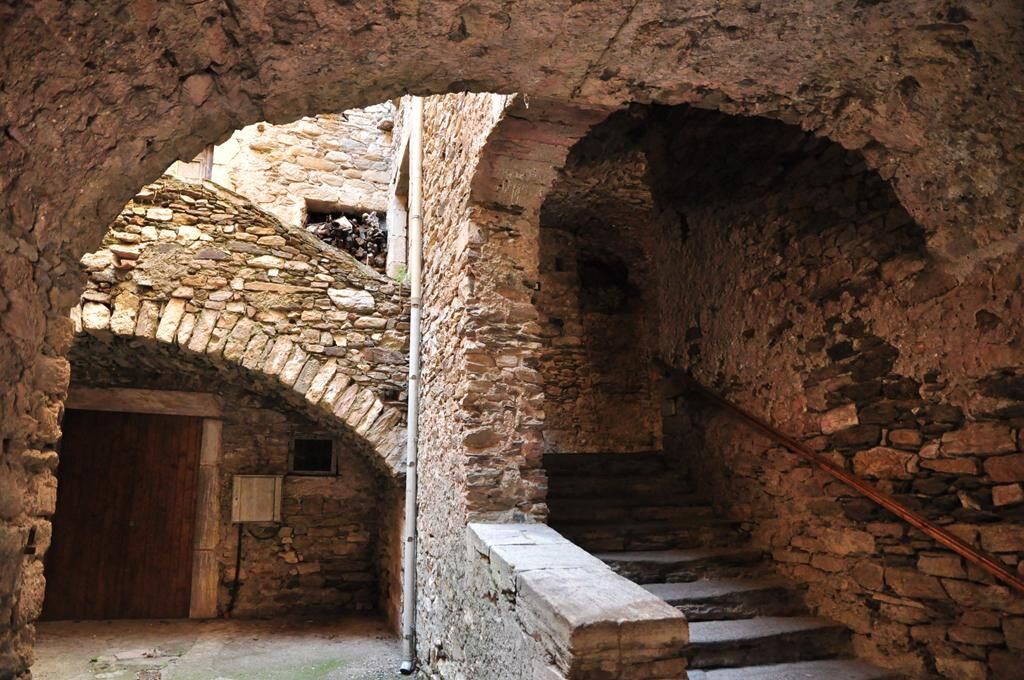
02- The old priory on Balad Street You are in the old priory, predating the medieval town. It depended on the Cassan abbey, like that of Saint-Julien. On the left remains a private tower with a spiral staircase; on the right, a Romanesque arch could be from the old chapel. Further on there was a workshop making custom pruning shears in the 19th century.
4
03- The Priory House Above the 12th-century door is the emblem of Olargues: an 'oule', symbol of wealth, surrounded by four mitres evoking the power of the abbot of Cassan. This place hosted a vicar before becoming the town hall until 1936. With your back to the Priory House, go down to the right towards the New Gate.
5
04- New Gate The New Gate, one of the main entrances to the castrum, had a portcullis and drawbridge. Above, the rampart walk is still visible. Olargues experienced occupations and incursions before becoming, from the 12th to the 14th century, one of the strongest places in Languedoc. Under the Pontil, a dead end reveals old arrow slits.
6
05- The Rampart Here you can admire the most visible part of Olargues' ramparts. The stones used are gneiss and marble. You can even see the arrow slits designed to repel many assailants...
7
06- The church, the consuls' house The current church, inaugurated in 1688, was built with stones from the castle demolished by order of Louis XIII after the Wars of Religion. It houses a 19th-century organ and marble altars from Carrara and Caunes-Minervois. The Commandery staircase formerly belonged to a large complex of the Hospitallers of Saint John of Jerusalem. Bought by the commune a century ago, it was transformed into a public path to directly connect the church to the lower part of the village. It testifies to the importance of the commandery in medieval Olargues.
8
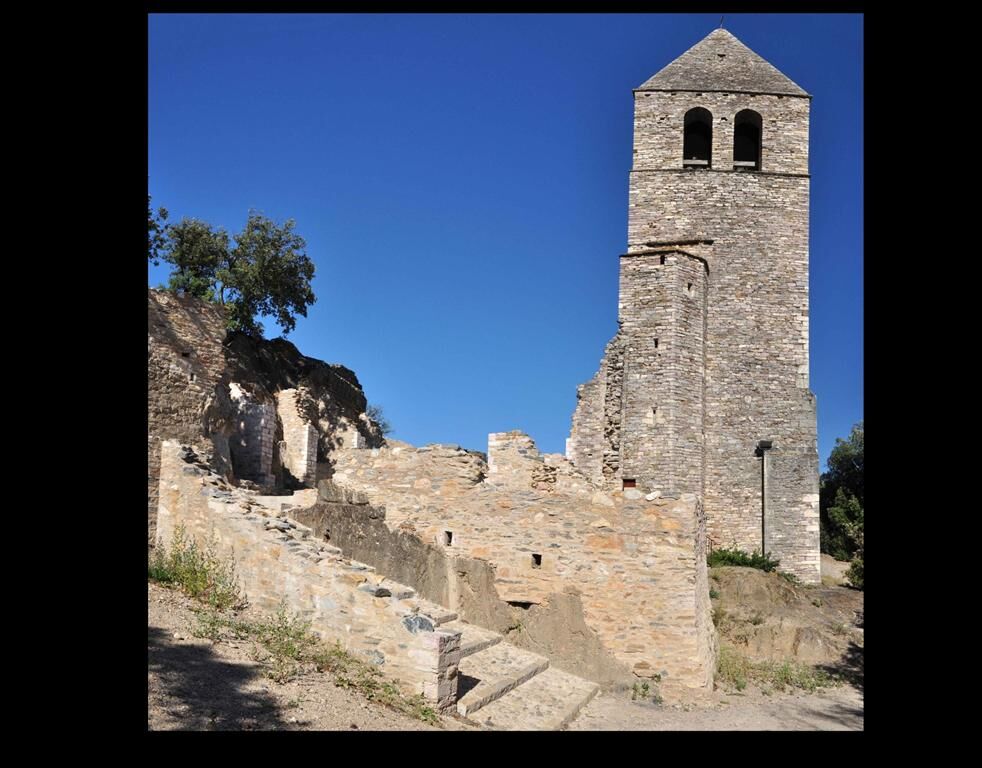
07- The Castrum The castrum of Olargues, founded in 1127 on a promontory protected by the Jaur, quickly became a powerful fortress. Around the castle developed the Saint-Laurent church, lordly residences, workshops, and communal ovens, of which ramparts, paved paths, and cellars still remain. Exploring the site, you discover the courtyard of the ovens, the cistern, old houses, and the main tower, transformed into a bell tower in the 17th century.
9
08- The Pillages Going down towards Mazel street, whose name evokes the massacres of the Wars of Religion, you cross an area marked by the pillages of the 16th century. In 1583, the band of the cruel Pierre de Moussou terrorized Olargues before being eliminated by his own lord, Boissezon, who then imposed an even harsher domination. These episodes left a strong mark on local memory.
10
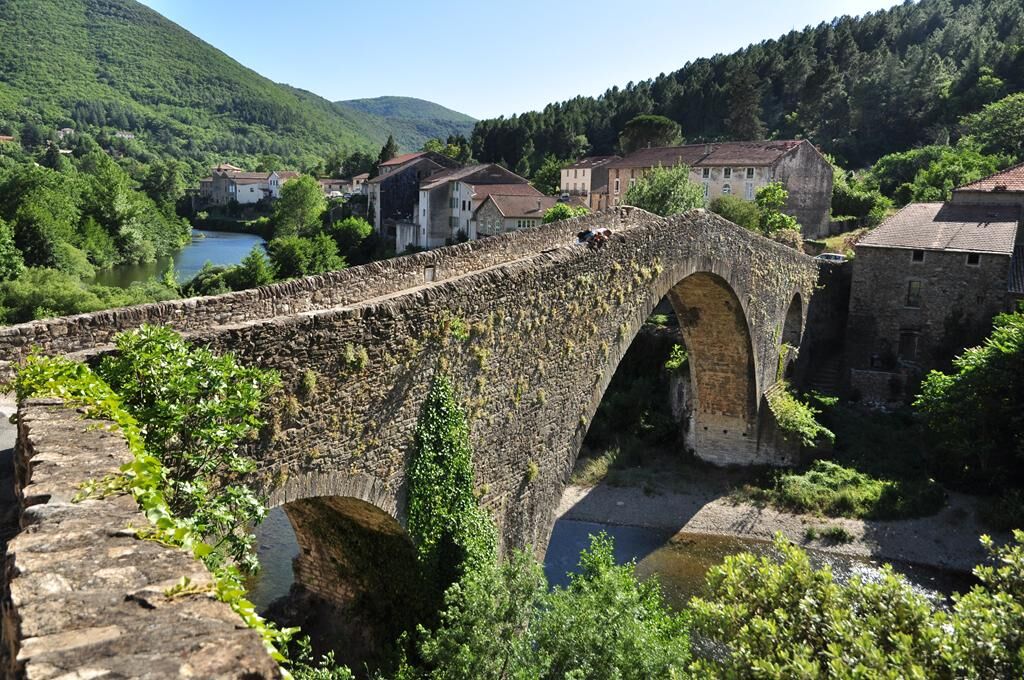
09- The Old Bridge Built around 1150 and inaugurated in 1160, the Old Bridge — today called the Devil's Bridge — remains one of Olargues' jewels. Over 100 meters long, built with local marble, it connected the Nîmes-Toulouse road and played a major role in the growth of the medieval village. Its large arch of 32.6 meters still impresses. In the past, young people gathered here for the "bridge tour", which often ended with dance evenings at the foot of the bridge.
11
10- The Jaur, The Jaur, angel and demon, powered several mills, including a grain and oil mill near the Devil's Bridge. But the river was also the source of terrible floods: that of 1723 devastated the entire valley, and in 1875 the water reached the mark visible above the mill gate. Despite these episodes, Olargues was spared thanks to the ancient wisdom of never building along the watercourse.
12
11- Vicomtes Space You are in front of the Vicomtes Space, likely the location of a lordly residence belonging in the 17th century to the vicomte of Thézan-Poujol, baron of Olargues. The lords stayed here to administer justice. Opposite is the last timber-framed house in the village, once equipped with a dovecote, a stable, and a barnyard, now hidden by plaster.
13
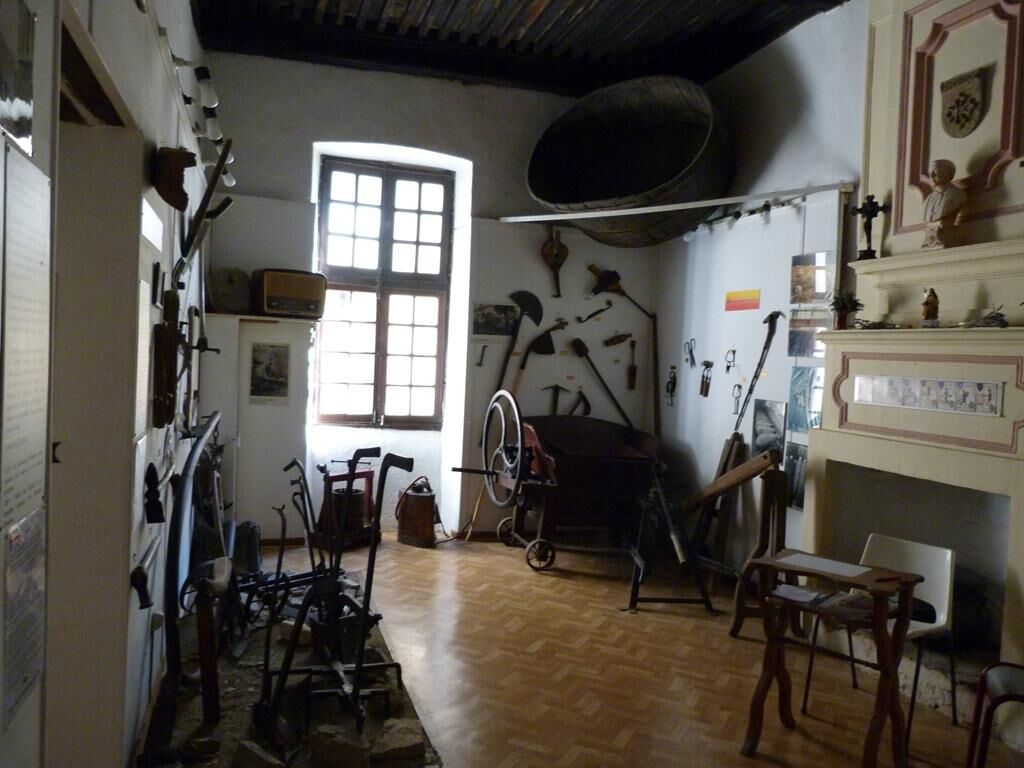
12- Commandery Staircase and Museum The Commandery staircase, built in the 14th century by the Hospitallers of Saint John of Jerusalem. The building now houses the Museum of Popular Traditions, the memory of Olargues, presenting agricultural tools, models, local history, and geological and prehistoric discoveries. We invite you to visit it.
14
13- Verdier Square Verdier Square is the oldest large square in Olargues, once lively with the Café de France and Jeanne's café. A central gathering place, it had 111 shops for 1000 inhabitants at the beginning of the 20th century. The square also served as a filming location for "Merci la vie" and the TV film "Red Alert", where locals played their own roles. Take the staircase at the back of the square to go down along the ramparts.
+33 4 67 97 70 79
Town Hall
Oblíbené prohlídky v okolí
- 4,0
GORGES DE COLOMBIERES HIKE
středníTuristika 12,0 km - 5,0
HIKING OF THE HÉRIC GORGES VIA THE ORIENTATION TABLE
středníTuristika 16,3 km - 4,0
CAROUX SUMMIT HIKE
středníTuristika 7,94 km - 5,0
HIKING ROUTE OF THE TERRASSES DE L'ESPINOUSE
středníTuristika 16,8 km - 4,0
LEGENDS TRAIL HIKE
středníTuristika 11,4 km - 3,0
CYCLE LOOP No. 29 - FROM THE VALLEYS TO THE PEAKS OF HAUT-LANGUEDOC
středníJízda na kole 64,3 km HERIC GORGES ROAD - MONS LA TRIVALLE
středníTuristika 9,38 kmTOUR DE LAC DE VESOLES HIKE
světloTuristika 6,27 kmHIKING OF THE ROQUANDOUIRE GATEWAY
středníTuristika 10,5 kmRANDONNEE L'AYROLLE
středníTuristika 8,13 km
Pěší turistika a stopování


Nenechte si ujít nabídky a inspiraci pro vaši příští dovolenou
Vaše e-mailová adresa byl přidán do poštovního seznamu.